
How can you fact-check the health information you find online?

How do we find out whether a claim is true or not?
We review summaries of evidence in a manner consistent with other major organizations, and share what we know about how strong the evidence is and whether something is or is not associated with cancer. Our editorial staff verify or refute claims using the best available studies in humans and laboratory/supporting studies. We go to reliable sources of scientific data, including medical and scientific journals, obtain expert opinions by leading scientists, and abstract information from reputable organizations such as the American Cancer Society and the National Institutes of Health.
Learn to fact-check
The CRAP Method
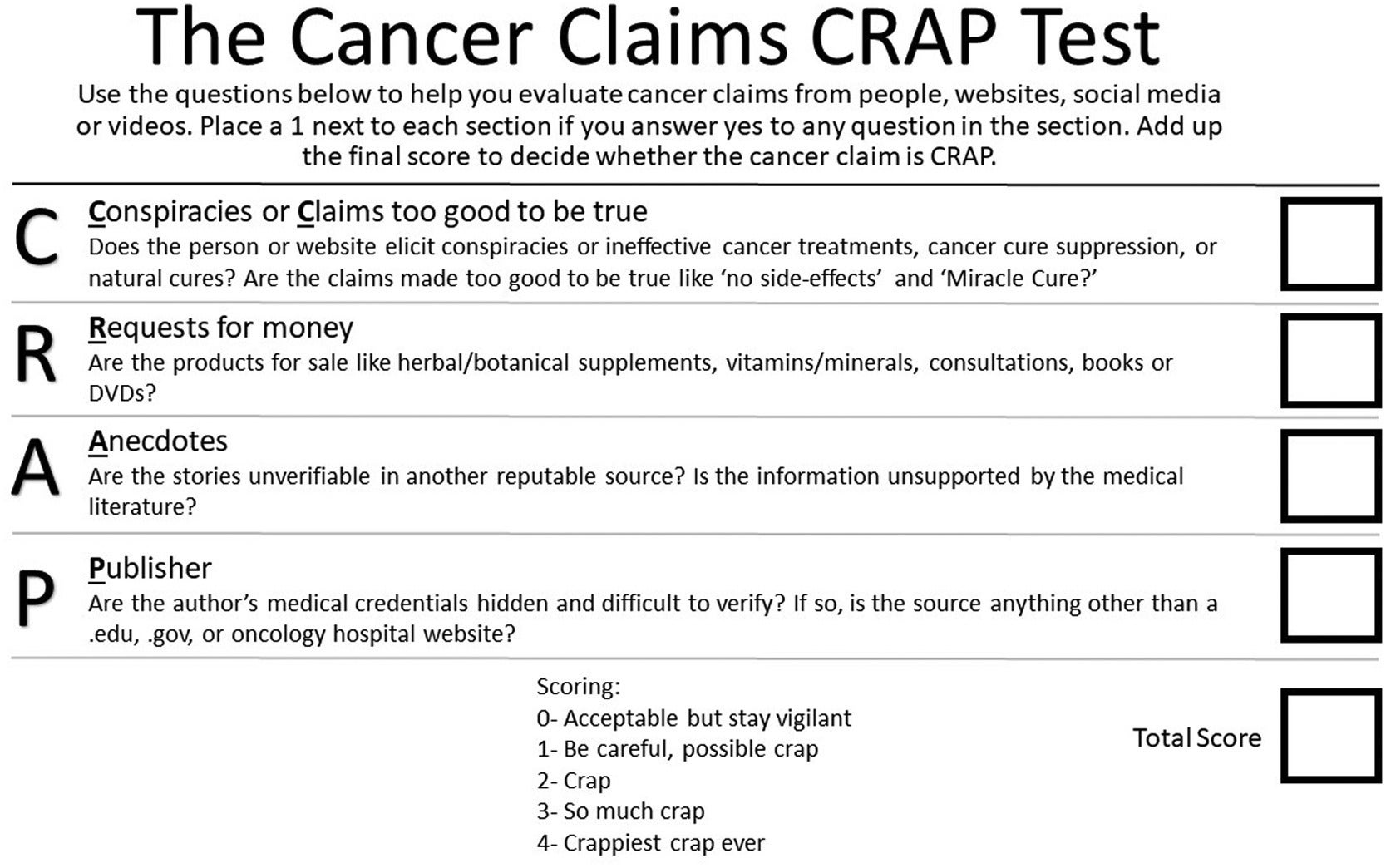
The Cancer Claims CRAP Test
Use the questions below to help you evaluate cancer claims from people, websites, social media or videos. Place a 1 next to each section if you answer yes to any question in the section. Add up the final score to decide whether the cancer claim is CRAP.
C — Conspiracies or Claims too good to be true
Does the person or website elicit conspiracies or ineffective cancer treatments, cancer cure suppression, or natural cures? Are the claims made too good to be true like ‘no side-effects’ and ‘Miracle Cure?’
R — Requests for money
Are the products for sale like herbal/botanical supplements, vitamins/minerals, consultations, books or DVDs?
A — Anecdotes
Are the stories unverifiable in another reputable source? Is the information unsupported by the medical literature?
P — Publisher
Are the author’s medical credentials hidden and difficult to verify? If so, is the source anything other than a .edu, .gov, or oncology hospital website?
Scoring:
0 – Acceptable but stay vigilant
1 – Be careful, possible crap
2 – Crap
3 – So much crap
4 – Crappiest crap ever
Total Score
The CRAP Method was created by Skyler Johnson, MD, an assistant professor of radiation oncology at Huntsman Cancer Institute as an easy way to remember how to evaluate online health information. Be suspicious of online information that sounds too good to be true or discusses conspiracy theories, requests money, uses personal stories in place of data to support claims, and originate from a ".com" website or some other questionable source.
The CARE checklist is another way to determine which sources are reliable and which are not.
C_laim
Does the claim seem outrageous, have overly complicated information, discuss primarily natural cures, and false timelines (too quick to seem true)?
A_cceptable
Verify the claim with other reputable sources. Look through the information for any grammatical and spelling errors. Professional articles have a clear style and are professionally edited. Is there structure to the website or article? Does it seem that the author has other reputable writing pieces?
R_equest
Is the website/source asking for the reader to buy certain products (such as supplements, natural remedies, and cures), donate, or provide payment to the website? Do not visit third-party websites requested by the source, and never give out personal information.
E_vidence
Does the author verify their claim using reputable sources? Do they cite and mention where all the information was obtained? (Reliable sources may end with .edu or .gov and include hospital and other websites that are .org.)
The CARE checklist
Doing your own fact-checking
Doing your own fact-checking
How can you sift through the massive amounts of information and pick out what is accurate and reliable? Consider the steps below when reading health information.
Read beyond the title. Read the entire article to find out what the article is really saying. Do not fall for dramatic and shocking titles.
Check:
• Who wrote it?
What are the author’s credentials and reputation? What other work do they do? Who pays them? Are they trying to sell something?
• Who published it?
Is the sponsor of the information well known and trusted? Is the information coming from a for-profit company?
• Is it fact or opinion?
Does the author have legitimate expertise in the area and present data, or is the article centered around opinions? Are reliable sources being cited?
• How recent is the article?
Older articles may have outdated information. If you are not sure, look for more recent articles.
• Is it a scam?
Does the information lead you to a third-party website? Are they asking you to buy something or provide personal information? Is it a sponsored post or an advertisement?
• How is the writing style?
There should not be grammatical or spelling errors. The writing should have a clear style and be professionally edited.
After checking these items, double-check! Verify the claims of the article by finding a second independent reliable source of information.
Assessing online information
Social media and other internet sources are valuable and easily accessible resources for many of us to find answers to our questions. Following is summary of the benefits and disadvantages of using the internet for health information: